


Skin Quality vs. Facial Volume: What Actually Makes You Look Younger?


For years, the conversation around facial aging has centered on one idea: replace what has been lost. Lost volume? Add filler. Lost definition? Add structure. Lost fullness? Restore it. But aging is not simply a story of volume disappearing.
Your skin is changing. Your collagen is declining. Pigment is accumulating. Elasticity is shifting. Tissue becomes less resilient. Facial fat compartments change position and proportion. Bone structure remodels. And the skin that once reflected light evenly begins to show texture, laxity, and uneven tone.
This is why aging well is not about putting volume back where it used to be. It is about understanding the biology of what is changing and knowing which changes actually need to be addressed.
At Savannah Tadin Aesthetics, we think about aesthetics differently: Biology first. Artistry second.
Skin Quality Is More Than “Good Skin”
When someone says their skin looks “older,” they may not actually be noticing a lack of facial volume. They may be seeing texture, pigmentation, laxity, fine lines, dullness, or a loss of firmness and luminosity.
Skin quality is the combined expression of several biological processes, including collagen production, elastin integrity, hydration, cellular turnover, pigmentation, and the way light reflects from the skin's surface.
Think about the difference between two faces with similar facial structure.
One may have smooth, even-toned, resilient skin with a healthy surface reflection. The other may have the same general volume but show sun damage, uneven pigmentation, fine lines, and reduced firmness.
Adding volume to the second face doesn't necessarily address the reason it looks more aged. Because volume and skin quality are two different conversations.
Collagen Changes the Equation
Collagen is one of the structural proteins responsible for the skin's strength, firmness, and resilience. As we age, collagen production declines and existing collagen becomes increasingly fragmented and less organized. The result can be thinner, less resilient skin and a gradual loss of firmness.
This is one reason modern aesthetics is moving beyond the traditional concept of simply replacing volume.
Instead of asking: “Where have we lost volume?” We can also ask: “What is happening to the quality of the tissue?” That shift changes the treatment conversation.
Collagen-stimulating treatments, resurfacing technologies, microneedling, regenerative approaches, and carefully selected injectables can each address different components of facial aging.
The goal isn't necessarily to make the face fuller. The goal is to improve the tissue you're working with.
Pigmentation and Texture Matter More Than You Think
One of the most overlooked components of perceived facial aging is surface quality.
Sun exposure, hormonal changes, inflammation, and time can contribute to uneven pigmentation, enlarged pores, rough texture, and visible photodamage.
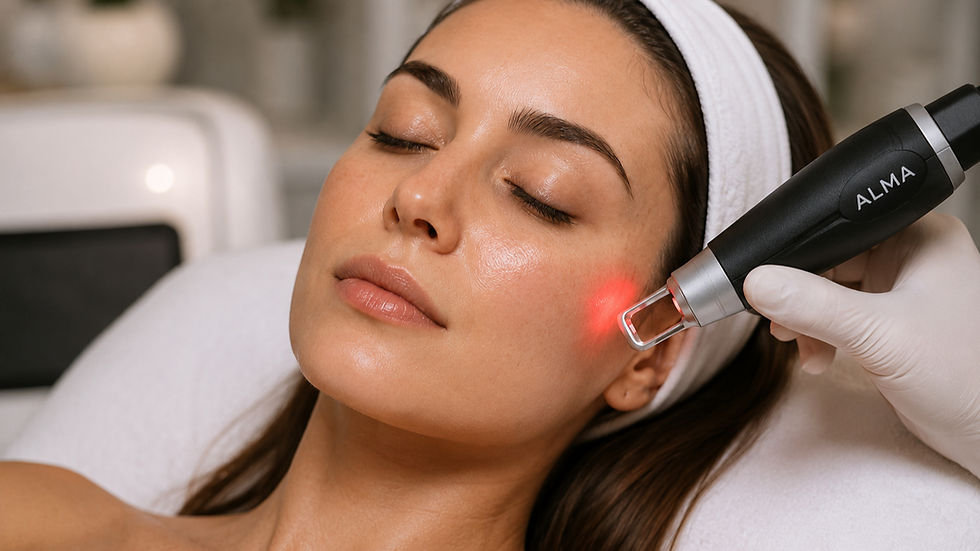
These changes don't necessarily alter the structure of the face but they can significantly affect how youthful, healthy, or vibrant the skin appears. This is where energy-based treatments and targeted skin therapies can play an important role.
Improving pigmentation and texture can change the way light interacts with the skin, creating a smoother, more even appearance without changing the underlying identity of the face.
Firmness Is Not the Same as Volume
Another common misconception is that loose or lax skin automatically needs filler.But firmness and volume are not interchangeable.
Skin can lose elasticity even when sufficient facial volume remains. Tissue can become less resilient, and structural changes can occur across multiple layers of the face.
This is why treating facial aging effectively often requires looking at the entire system: Skin. Collagen. Fat. Muscle. Bone. Each layer changes differently, at a different pace.
And each patient expresses those changes differently.
For one person, improving skin quality may create the most meaningful improvement. For another, restoring a small amount of strategic volume may help rebalance the face. Someone else may benefit from a combination of collagen stimulation and energy-based treatment.
There is no universal aging protocol. There is only the biology in front of us.
So, What Actually Makes You Look Younger?
There isn't one answer.
It is the relationship between skin quality, tissue health, facial structure, proportion, and time.
Healthy-looking skin with improved texture and tone can make the face appear more vibrant.
Improved firmness can restore a sense of resilience.
Strategic correction of pigmentation can create a more even complexion.
Collagen stimulation can support the quality of the tissue.
And when appropriate, carefully placed volume can restore structural balance without changing the character of the face.
The objective isn't to recreate your 25-year-old face, It is to help your current face perform at its highest level.
The future of aesthetics is not necessarily about doing more. It's about understanding more.
More about collagen.
More about cellular function.
More about tissue quality.
More about facial anatomy.
More about how skin changes over time.
At Savannah Tadin Aesthetics, we approach aesthetic medicine through that lens:
A personalized consultation can help determine whether your concerns are primarily related to skin quality, pigmentation, collagen, firmness, facial structure or a combination of them.
Because better aesthetics begins with better understanding.


Comments